running man
“钼”成300层+NAND必选项 机构:沉积设备迎10亿美元增量市场_我的网站

A | 当地时间8月23日,半导体行业研究机构SemiAnalysis发文称,NAND闪存制造正从钨转向钼,因为当NAND来到300层以上,钼是必选项。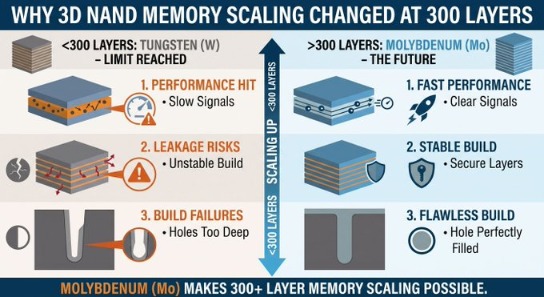 SemiAnalysis分析,3D NAND闪存堆叠层数突破300层后,钨字线在电阻、化学兼容性和深孔填充三方面均触及物理极限,钼成为强制替代材料。
China continues to be the leading destination for Brazilian soybeans, and the Brazilian soybean industry wants to further deepen this relationship, expecting historically high volumes in the coming months, the Brazilian Association of Soybean Growers (Aprosoja Brasil) told the Global Times on Friday.
Brazilian soybean exports to China have remained very strong. China imported 12.08 million tons of soybeans from Brazil in June, up 13.7 percent year-on-year, while imports from the US fell 20.9 percent year-on-year to 1.27 million tons, according to data from the General Administration of Customs.
China imported 34.75 million tons of soybeans from Brazil during the period, up 9.1 percent year-on-year, according to Aprosoja Brasil. "Based on arrivals and customs clearance in China, there was clear growth," the association said.
According to the official data platform Brazilian Comex Stat, which records shipments at origin, 48.32 million metric tons were destined for China from January through June, largely unchanged from 48.41 million metric tons during the same period in 2025.
The difference between the two datasets mainly reflects timing and methodological differences between the recording of departures, cargoes in transit, arrivals and customs clearance.
Aprosoja Brasil said that the broader economic conclusion is the same: "Trade flows remained historically strong, China continued to be the leading destination for Brazilian soybeans, and Brazil's total soybean exports reached a first-half record of 69.57 million metric tons."
For farmers, strong export volumes help support the marketing of the crop, although record exports do not automatically mean record farm margins, said the Brazilian industry association.
China is the world's largest soybean importer. Imported soybeans are mainly used for oil production and animal feed. In terms of trading partners, China mainly imports soybean-related products from Brazil, the US, Argentina, Uruguay and Canada.
Brazil ranks among the world's leading soybean producers and exporters, with China being its largest export market for soybeans, according to the Xinhua News Agency.
Commenting on the significance of the Chinese market, Aprosoja Brasil said "China is absolutely strategic to Brazil's soybean industry," citing data showing that in 2025, China purchased 85.4 million metric tons, representing approximately 79 percent of all Brazilian soybean exports.
The two countries also have a highly complementary trade relationship. For Brazilian farmers, Chinese demand provides scale, market liquidity and greater capacity for long-term planning, said the Brazilian soybean industry association. For China, Brazil offers large, competitive and reliable supplies, as well as a crop calendar that complements production in other supplying countries.
Previously, policy shifts, such as US unilateral tariff measures, have caused disruption for US soybean farmers and other agricultural producers, Lü Xiang, research fellow at the Chinese Academy of Social Sciences, told the Global Times.
At the same time, China has been diversifying imports, including from Brazil and Argentina, to reduce risks from trade uncertainty, according to Lü.
Aprosoja Brasil noted that this partnership should not be seen merely as a temporary consequence of trade disputes involving third countries. Instead, it is a structural and mutually beneficial relationship, based on the complementarity between Brazil's production capacity and China's large demand for food, animal feed and protein, the industry group said.
Looking ahead to the soybean trade for the rest of the year, Aprosoja Brasil said that they are positive, while having a prudent mindset. Brazil has completed the harvest of a record soybean crop of approximately 180.6 million metric tons, and Brazilian soybean exports are expected to reach 116.3 million metric tons in 2026, which would also be a record, the association said.
"Brazil therefore has sufficient supply to continue serving the Chinese market strongly in the coming months... We expect historically high volumes, although not necessarily growth every single month, because soybean trade is seasonal and Northern Hemisphere supplies become more prominent during the second half of the year," it said.
。

B | 三星已于2024年量产,美光2025年跟进,SK海力士计划2026年底推出375层钼工艺产品。其估计,钼在NAND总产能中的占比将从2025年的中个位数百分比,增长至2027年的约30%。 更进一步的,该机构提出,钼沉积设备将在明年迎来超10亿美元的新增市场。

C | 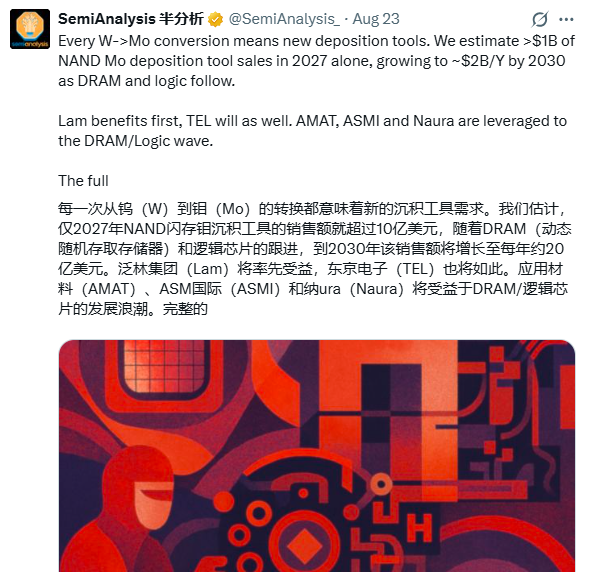 该机构称,每一次从钨到钼的转换,都意味着需要新的沉积设备。SemiAnalysis估计,仅2027年一年,NAND钼沉积设备的销售额就将超过10亿美元,并随着DRAM和逻辑芯片的跟进,到2030年增长至约20亿美元/年。 受益格局方面,Lam Research(泛林集团)最先获益,TEL(东京电子)紧随其后;AMAT(应用材料)、ASMI(ASM国际)及Naura(北方华创)则更多受益于后续DRAM和逻辑芯片的转型浪潮。

D | SemiAnalysis表示,完整的细分市场层面测算已纳入其前道设备(WFE)模型。 钼渗透率在高层数NAND中提升,本质是为延续NAND单位Bit成本下降曲线。 300层NAND主要在结构上升级,聚焦超高深宽比通道孔刻蚀、多次Stack堆叠、晶圆翘曲控制以及Overlay精度控制。 375层乃至400层以后,材料亟需升级,因钨字线会因为字线间距通道孔缩小面临RC延迟快速恶化、WF残氟导致介质损伤、漏电失效率提升以及填充缺陷放大的问题。而钼凭借更低电阻率、无氟前驱体及无需阻隔层等优势,有望改善RC性能与器件可靠性,为字线和存储孔缩放提供工艺余量,从而延续高层数NAND的成本下降曲线。

E | 中银证券表示,SK海力士已完成375层3D NAND生产验证并计划2026年底量产,拟采用钼材料替代钨制作字线,继三星在286层第九代3D NAND中率先导入钼工艺后,两大存储龙头相继切换,钼替代钨趋势确立。 然而,钼的材料加工更为复杂,因为必须以气体形式输送,且前驱物在室温下为固体,需要加热器以确保流动稳定性。 基于此,300层以上3D NAND字线由钨切换为钼,并不是简单更换靶材或者更换气体材料,而是前驱体供给、ALD沉积腔体、刻蚀、清洗、尾气处理整套工艺链条的重构,原有钨CVD产线硬件无法直接复用,将直接推动晶圆厂资本开支上行,同时设备、特种材料、零部件均迎来变化。 爱建证券表示,钼导入本质是一次全流程工艺重构,设备链受益有望沿“沉积及前驱体输送→CMP及清洗→刻蚀→量检测”路径传导,工艺难点由沉积向后处理环节延伸。其中—— 沉积:成熟的WF钨工艺,Mo沉积需重新建立高深宽比结构下的填充与缺陷控制工艺窗口,同时有望减少阻隔层使用,带动沉积设备及配套工艺升级; 输送:Mo前驱体通常采用低挥发性固态源,与传统WF气态前驱体体系差异较大,需要新增气化装置、温控管路及精密供气系统,以保障前驱体稳定输送; CMP:Mo材料的氧化及表面化学特性不同于传统金属体系,需重新开发CMP研磨液和研磨垫,以满足平坦化、去除速率及缺陷控制要求; 清洗:Mo导入后残留物及氧化物体系发生变化,高深宽比结构下金属残留和污染控制难度提升,有望推动相关湿法清洗设备及配套化学品验证导入; 刻蚀环节则需重新建立适配钼材料的工艺窗口,且3DNAND层数持续提升下,刻蚀选择性、侧壁形貌控制及层间均匀性要求进一步提高,有望带动相关刻蚀设备升级需求; 量检测:Mo量产还需新增膜厚均匀性、填充缺陷、金属残留及电学可靠性等监控项目,有望带动薄膜量测、缺陷检测及电性测试等设备需求增长。

F | 该机构称,NAND工艺迭代核心从单纯堆叠层数转向材料—设备—工艺协同创新,新材料导入将持续催生沉积、刻蚀、清洗等关键设备迭代升级,Mo字线导入将推动沉积、刻蚀、清洗等关键环节工艺升级,相关设备及零部件厂商有望受益。 (文章来源:科创板日报)。
Current article:http://kvdh9.chengjuecannaobianmouqueduoyu.shop/list_fpcre1f/dvg.html
Published on:04:57:36


